
Free Kundli Online - Generate your Janam Kundli by Date of Birth
Get your complete birth chart with detailed planetary positions, houses, and predictions based on Vedic astrology.
Chances are someone in your family has mentioned your Kundli at least once before a big decision, before a wedding, or just as something you should "get made" someday. If you've never actually seen yours, this is where that changes.
 Trusted by 10M+ users
Detailed Charts
North & South Indian
Planetary Analysis
All 9 planets
Dasha Predictions
Life period analysis
Life Predictions
Career, love & more
Your Kundli
Your Janam Kundli is a snapshot of the sky at the exact moment you took your first breath. Every planet, every degree, and every house is fixed to that precise instant. It is not a generalized reading based on your birth month. It is specific to you in a way no horoscope column ever could be.
Enter your date, time, and place of birth above and AstroTime builds your Kundli instantly, for free, in Hindi or English. Scroll through this section to understand exactly what each part of your chart means and where to begin.
What Is Inside Your Kundli
Your free Kundli includes everything a Vedic astrologer would normally draw and calculate manually, generated in seconds:
- Lagna chart with planets in 12 houses
- Navamsa chart (D9) for marriage and dharma
- Rashi (Moon sign) and Lagna (Ascendant)
- Nakshatra with pada (quarter)
- Planetary positions for all 9 planets (Navagraha)
- Dosha checks: Mangal, Kaal Sarp, and Pitra Dosha
- Vimshottari Dasha with Mahadasha and Antardasha dates
- Predictions for career, marriage, money, and health
- Choice of language (Hindi or English) and chart style (North or South Indian)
Why This Kundli Is Different from a Western Chart
AstroTime calculations use Lahiri Ayanamsa, the sidereal system formally adopted by the Indian government's Rashtriya Panchang Reform Committee and used by professional Vedic astrologers across India.
This is why your Vedic Kundli can look different from a Western chart, and why your Vedic sign may differ from the sign you have always known. It is not an error. Vedic astrology tracks the actual stellar positions, not the tropical seasonal zodiac.
Three Inputs. One That Most People Get Wrong.
- Date of birth: locks in planetary positions for that day.
- Place of birth: needed to compute Ascendant from exact latitude and longitude.
- Time of birth: the most critical input. Lagna shifts roughly every 2 hours, and even a 15-minute error can shift house placements.
How to Find Your Actual Birth Time
In order of reliability, use these sources:
- Birth certificate (hospital or municipality issued)
- Hospital discharge summary
- Your mother's recollection
- Family astrologer records from the time of birth
- Birth time rectification using life events, dasha periods, and transits
If no time record exists, you can still generate a chart with date and place. You will get Sun sign, Moon sign, and broad dasha timelines, but house-based predictions require accurate birth time.
Where to Start When You Open Your Kundli
- Lagna (Ascendant): your first-house anchor and personal expression pattern.
- Moon sign (Rashi): central to daily readings and emotional patterns in Vedic astrology.
- Current Mahadasha: the major life period shaping ongoing themes, shown with start and end dates.
The 12 Houses at a Glance
| House | Sanskrit Name | Represents |
|---|---|---|
| 1st | Tanu Bhava | Self, body, personality |
| 2nd | Dhana Bhava | Wealth, family, speech |
| 3rd | Sahaja Bhava | Siblings, courage, communication |
| 4th | Sukha Bhava | Mother, home, property |
| 5th | Putra Bhava | Children, creativity, education |
| 6th | Ari Bhava | Health, debt, daily work |
| 7th | Yuvati Bhava | Marriage, partnerships |
| 8th | Ayur Bhava | Longevity, transformations |
| 9th | Bhagya Bhava | Father, fortune, dharma |
| 10th | Karma Bhava | Career, public reputation |
| 11th | Labha Bhava | Gains, friendships |
| 12th | Vyaya Bhava | Loss, expenditure, moksha |
Divisional Charts and What They Are For
- D1 (Rashi/Lagna): the primary birth chart and base reference.
- D9 (Navamsa): used deeply for marriage, dharma, and planetary strength checks.
- D10 (Dashamsha): focused on career, profession, and public work.
Your free AstroTime Kundli includes D1 and D9. Full Shodashvarga interpretation is usually part of one-on-one expert consultation.
North Indian or South Indian Chart Style
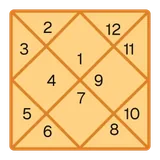
Both chart styles represent the exact same data: same planets, same houses, same results. The difference is visual layout. North style is a diamond pattern. South style is a square grid.
If your family astrologer prefers one style, use that for easier discussion. If you are new, choose either and stay consistent while learning.
What To Do Next
- Start with Lagna, Moon sign, and current Mahadasha from your generated chart.
- For marriage, continue to Kundli Matching.
- For daily guidance, check Today's Horoscope.
- For muhurat and timing, use Today's Panchang.
- For personal advice, chat with a verified astrologer in the app.
Frequently Asked Questions
What if I do not know my exact birth time?
You can still generate a partial chart using date and place of birth. Sun sign, Moon sign, and broad dasha periods will still be useful. House-based predictions depend on Lagna, so accurate time is important. If records are unavailable, birth time rectification can help.
What is the difference between Kundli and Horoscope?
A Kundli is your lifelong personal birth map, created from your exact birth details. A horoscope is a daily, weekly, or monthly forecast for many people with the same sign.
Should I choose North Indian or South Indian style?
Both styles show the same planetary placements. Choose the one your family or astrologer uses, or pick one and stay consistent while learning.
Is Vedic Kundli different from Western birth charts?
Yes. Vedic astrology uses the sidereal zodiac and Western astrology uses the tropical zodiac. For Kundli matching, doshas, dashas, and muhurat, Vedic calculations are the standard in India.
What is the Navamsa chart and why does it matter?
Navamsa (D9) is a divisional chart used heavily for marriage insights and verifying true planetary strength. It is an essential companion to the main D1 chart.
Which ayanamsa does AstroTime use?
AstroTime uses Lahiri (Chitrapaksha) Ayanamsa, the standard reference used by most professional Vedic astrologers in India.